Moving States? Beat the 30 Day HIPAA Clock With These 7 Steps
Transfer medical records when moving states using a compact checklist: invoke HIPAA's 30 day Right of Access, avoid prescription gaps, and keep a secure...

Moving States? Beat the 30 Day HIPAA Clock With These 7 Steps
Request and direct your records now. Submit a dated, written authorization naming your new provider (or ask for a copy sent to you) rather than waiting for your old office to act. Providers must respond within 30 days under HIPAA. Start this process several weeks before your move to ensure timely receipt of your records.
TL;DR:
- Request records by specific date ranges rather than entire files to speed up processing and minimize delays during transfer.
- Always keep a personal encrypted digital copy of your health records to avoid dependence on provider responses or potential loss.
- HIPAA requires providers to respond within 30 days, but some states have shorter deadlines, and follow-up in writing is essential if they miss it.
- For medication continuity, especially controlled substances, coordinate with your pharmacy and schedule in-person visits with new providers before running out.
- Use record transfer methods that provide proof, such as secure email or fax confirmation, to establish clear legal documentation if issues arise.
Table of Contents
- How Do You Transfer Medical Records When Moving States?
- What Medical Records Should You Actually Request?
- How Long Does HIPAA Give Providers to Send Records?
- Keeping Your Prescriptions Filled Across State Lines
- Small Moves That Prevent Big Delays
- Does Every State Follow the Same Records Rules?
- Why a Personal Digital Copy Matters More Than People Think
- Build Your Move-Ready Health Record Before You Pack a Single Box
- Where to Verify These Rules Yourself
- A Straight Answer About Why This Process Feels Harder Than It Should
- Sources
How Do You Transfer Medical Records When Moving States?
Getting your medical history from one state to the next is not automatic. Providers do not forward files just because you switched addresses. You have to request the transfer, and the process moves faster when you follow it in order.
Here’s the checklist, start to finish:
- Identify your providers. List every doctor, specialist, dentist, and mental health provider you’ve seen in the last 3 to 5 years, along with their office contact information.
- Gather your new provider’s details. You’ll need the name, address, and fax or secure email of the office receiving your records, if you already have one lined up.
- Choose your records and date ranges. Decide what you actually need (more on this below) instead of requesting “everything.”
- Submit the request. Complete each provider’s official release form, or send a dated letter authorizing release. Specify electronic delivery when it’s offered. Medical records don’t transfer automatically; HIPAA gives you the right to direct your information to anyone you choose, no explanation required.
- Document everything. Save the email confirmation, fax receipt, or portal timestamp. This paper trail starts the legal response clock and protects you if a provider drags its feet.
- Follow up. Call the records department a week or two after submitting, then check with your new provider’s office to confirm the file actually arrived and is readable.
- Confirm before your first appointment. Don’t assume delivery. Verify the new office has what it needs before you walk in.
- If a provider’s office has closed, ask the local hospital system or your state medical board who now holds the records.
- If a provider retired without a clear successor, HIPAA still applies. The records custodian is legally obligated to fulfill your request.
- If an office goes silent, escalate in writing and reference your legal right of access.
Pro Tip: Check your provider’s patient portal before filing any formal request. Portals often give you instant access to labs and immunization records, and you can download or forward them yourself in minutes.
What Medical Records Should You Actually Request?
Not every document matters equally for continuity of care. A new doctor needs specific things fast, not a decade of paperwork.
- Summary of care and current medication list. This is the single most useful document for a new provider. Make it your first priority.
- Labs and imaging from the last 2 to 3 years. Recent bloodwork, scans, and test results give your new doctor a baseline without re-ordering everything.
- Surgical and procedure notes, if you’ve had any operations or major procedures.
- Vaccination records, especially for school enrollment, new jobs, or travel.
- Device or implant documentation, if you have a pacemaker, insulin pump, or similar hardware.
- Specialist notes for any ongoing condition, from cardiology to oncology to physical therapy.
Mental health records often need a separate, specific consent form under state privacy laws, so don’t assume a general release covers them. Ask directly.
How Long Does HIPAA Give Providers to Send Records?
Federal law sets the baseline. Under HIPAA’s Right of Access, providers must fulfill a written request within 30 calendar days, with one permitted 30-day extension if they notify you in writing about the delay.
The 30-day rule has exceptions that work in your favor. Some states set tighter deadlines. For example, California requires records within a shorter timeframe than the federal standard. State law can only expand your access rights, never shrink them below the HIPAA floor.
You get to choose the format, and electronic copies are usually the fastest and cheapest option. Providers can charge reasonable, cost-based fees for paper copies and mailing, but portal access and electronic delivery are typically free or low-cost. If a provider blows past the deadline, follow up in writing citing your Right of Access, then file a complaint with the HHS Office for Civil Rights if they still don’t respond. OCR has enforced this rule before, and providers know it.
Keeping Your Prescriptions Filled Across State Lines
Running out of medication mid-move is one of the most avoidable problems on this list, and one of the most common.
- Ask your pharmacy about obtaining an extended supply before you leave, especially for maintenance medications.
- If you use a national pharmacy chain, coordinate the transfer to a location near your new address ahead of time so your profile and history move with you.
- Controlled substances need extra planning. DEA rules and state pharmacy boards vary, and many states won’t let an out-of-state prescriber’s controlled substance script transfer cleanly. Schedule a visit with a new in-state provider before your current supply runs out.
- Bring a printed prescription history and medication list to your first new-provider appointment. It speeds up renewals and prevents dangerous gaps.
Pro Tip: Don’t wait until you’re down to your last few pills to find a new prescriber, especially for anxiety medication, ADHD medication, or pain management. Some states require an in-person visit before a controlled substance can be prescribed to a new patient, and getting an appointment can take weeks.
Small Moves That Prevent Big Delays
A few tactical choices separate a smooth transfer from a frustrating one.
- Request by date range, not “everything.” A request for “labs and imaging from 2023 to present” moves through a records department far faster than a request for your entire file. Targeted requests reduce processing delays significantly compared to vague ones.
- Get a personal digital copy. Ask for a PDF or exported file for yourself, separate from what goes to your new provider. This protects you against lost faxes, scanning errors, or a transfer that stalls.
- Use a submission method that leaves proof. Secure email, fax with a confirmation page, or a portal message all create a timestamp. That timestamp is what starts the legal response window and what backs you up if you need to escalate.
- Track down closed practices early. If a former provider shut down, the state medical board or the hospital system that absorbed the practice usually holds the records custodian’s contact information.
Pro Tip: If you’re dealing with a complex history, cancer treatment, a transplant, multiple specialists, ask your current specialist for a written summary of care and a referral to a named provider in your new area. It’s faster than reconstructing your history from scratch with a new doctor who’s never seen you.
Does Every State Follow the Same Records Rules?
No, and this trips up a lot of people mid-move. HIPAA sets the federal floor, but individual states can, and do, layer on stricter rules. California’s 15-day response requirement is the clearest example, cutting the federal 30-day window by half.
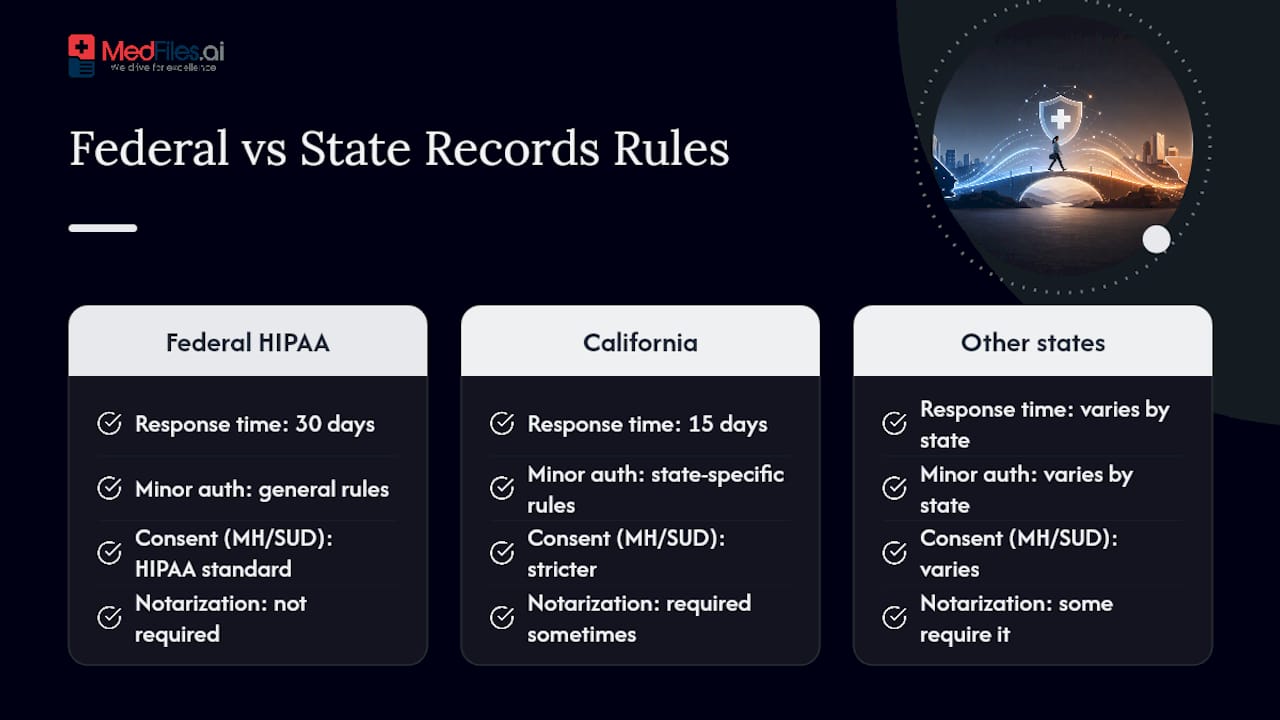
Some states also set different rules for who can authorize release of a minor’s records, how long a provider must retain files before destroying them, and what counts as valid consent for mental health or substance use treatment records. A few states require a notarized signature for certain sensitive record categories, while others accept a simple signed form.
Telehealth adds another wrinkle. If you’re mid-treatment with a therapist or psychiatrist by video, moving states can affect whether that provider is licensed to keep treating you at all, since most mental health licenses are state-specific. Understanding telehealth consent requirements before you move can save you from an abrupt gap in care.
The safest approach: don’t assume your home state’s rules travel with you. Check your new state’s health department website, or ask your current provider’s records department whether they’ve handled an interstate transfer to that state before. Many have, and they’ll know the shortcuts.
Why a Personal Digital Copy Matters More Than People Think
Provider-to-provider transfers fail more often than anyone admits. Fax numbers change, records departments lose requests, and offices merge or close without warning. That’s the real argument for holding your own encrypted copy alongside whatever your old provider sends directly.
A personal records platform gives you a backup that doesn’t depend on any single office’s follow-through. MedFiles.ai lets you manage profiles for your whole family (kids, aging parents, even pets) in one place, share records securely with a new provider the moment you find one, and export files in a format your new doctor’s office can actually read. That audit trail also means you know exactly when something was sent and whether it was opened.

The most reliable approach for complex medical histories combines both: request the official provider-to-provider transfer, and keep your own MedFiles.ai copy as insurance.
Build Your Move-Ready Health Record Before You Pack a Single Box
MedFiles.ai stores your medical history in one encrypted place, so you’re never stuck waiting on a fax machine to catch up with your zip code. Upload your records once, and you can securely share them with a new provider the day you find one, with a timestamp that proves exactly when it was sent and received.
That matters most in the weeks right after a move, when you need a new doctor to see your medication list, your last labs, and your specialist notes without a 30-day wait. MedFiles.ai’s multi-profile management also covers your whole household, so you’re not juggling separate systems for your kids, your parents, or your own care. Set it up now, before your provider’s records department even opens your request, and Medfiles so your health history is already move-ready when you arrive.
Where to Verify These Rules Yourself
For the federal rules governing your access rights, read the HHS guidance on the HIPAA Right of Access directly. For portal-based access and electronic format options, the ONC’s patient guidance walks through what you’re entitled to request and in what form.
A Straight Answer About Why This Process Feels Harder Than It Should
The uncomfortable truth about interstate medical record transfers: the system was never built for a mobile population. HIPAA gives you strong rights on paper, a 30-day clock, a choice of format, the ability to direct records anywhere you want, but it puts the entire burden of execution on you, the patient, at the exact moment you have the least bandwidth to chase down paperwork.
Most people treat records transfer as an afterthought wedged between hiring movers and forwarding mail. That’s backwards. A missed refill on a controlled substance or a gap in a specialist’s treatment notes causes real harm, not just inconvenience. The people who move through this smoothly are the ones who treat their medical history like they’d treat a lease or a mortgage: something you actively manage, not something you assume will follow you.
The other misconception worth correcting: many people think requesting “everything” is the thorough move. It’s actually the slow one. A records department handling a vague, all-inclusive request has to pull, review, and redact far more material than one handling a specific date-range request for labs and a medication list. Precision is what gets you fast turnaround, not volume.
If there’s one habit worth adopting permanently, it’s keeping your own copy of your records independent of any single provider’s system. Offices close, staff turn over, and fax machines fail silently. Your health history shouldn’t be hostage to any of that.
— Team
This article is general information, not a substitute for advice from a qualified doctor. Consult a qualified healthcare professional about your own circumstances before acting on anything here.
Sources
- Individuals’ Right under HIPAA to Access their Health Information (HHS)
- How to transfer medical records (Healthline)
- Get It - ONC (Office of the National Coordinator for Health IT)