WhatsApp and HIPAA: The One Exception U.S. Providers Need
WhatsApp is not HIPAA compliant. This U.S. focused explainer gives compliance officers a patient-request workflow, an eight item vendor checklist, and...

WhatsApp and HIPAA: The One Exception U.S. Providers Need
No, WhatsApp is not HIPAA compliant, and it should not carry protected health information. Meta will not sign a Business Associate Agreement for WhatsApp, WhatsApp Business, or the Business API, and encryption alone never satisfies the Security Rule. There is one narrow exception: a patient can request an unsecured channel for their own information, but only with documentation and clear limits. The sections below walk through the policy, the workaround, and what to use instead.
TL;DR:
- WhatsApp does not offer a signed Business Associate Agreement, making it non-compliant with HIPAA requirements for handling protected health information.
- The app lacks essential audit controls, role-based access, and retention capabilities needed for legal compliance and proper record-keeping.
- Its end-to-end encryption only protects data in transit, but it does not address storage, access, or metadata privacy issues that violate HIPAA safeguards.
- Using WhatsApp for PHI, even with patient consent, risks exposure due to device theft, lack of remote wipe, and unmanaged backup storage.
- Effective HIPAA-compliant messaging tools must include signed BAAs, audit logs, centralized controls, retention policies, and verified encryption at rest and in transit.
Table of Contents
- Is WhatsApp HIPAA Compliant? The BAA Requirement Explained
- Why WhatsApp Falls Short of HIPAA Compliance
- The Patient-Request Exception: What HIPAA Actually Allows
- Building an Organizational Policy for Consumer Messaging Apps
- What to Require From a HIPAA-Ready Messaging Solution
- The Perspective Gap Between Convenience and Compliance
- Replace WhatsApp Habits With a HIPAA-Ready Sharing Workflow
- Where This Guidance Comes From
- Sources
Is WhatsApp HIPAA Compliant? The BAA Requirement Explained
A messaging tool becomes HIPAA compliant only when a covered entity can sign a Business Associate Agreement with the vendor and the vendor’s actual safeguards match what the Security Rule demands. WhatsApp fails on the first count before you even get to the second. Meta does not offer a BAA for any version of WhatsApp, which by itself rules it out for transmitting PHI in a clinical or administrative context.
A business associate is any vendor that creates, receives, maintains, or transmits protected health information on behalf of a covered entity. Under HHS guidance on business associates, that relationship requires a signed contract spelling out permitted uses, security obligations, and breach notification duties. No signature, no compliant relationship, full stop. This is why hospital IT departments treat the BAA question as the first filter, not the last, when evaluating any communication app.
Once a BAA is in place, the Security Rule adds a second layer of requirements that a covered entity must verify independently. HHS Security Rule guidance breaks these into three categories:
- Administrative safeguards: risk analysis, workforce training, designated privacy and security officers, and documented sanctions for policy violations.
- Physical safeguards: facility access controls and device management, including procedures for lost or stolen phones.
- Technical safeguards: unique user identification, audit controls, data integrity protections, and transmission security.
Audit controls deserve special attention because they are the piece most consumer apps skip entirely. The Security Rule expects a covered entity to be able to answer, on demand, who accessed a given record and when. WhatsApp offers no administrative console, no exportable access log, and no way for a compliance officer to reconstruct who read a message thread six months after the fact.
Retention is the other quiet dealbreaker. Medical records laws in most states require retention periods ranging from several years to permanently for certain pediatric records, and the Security Rule expects covered entities to be able to produce relevant communications during an audit or legal discovery request. An app built around disappearing messages and unmanaged local storage works against that obligation rather than for it.
Cloud hosting adds one more wrinkle. HHS guidance on cloud computing makes clear that a covered entity remains responsible for verifying where PHI is stored, how it’s encrypted at rest, and whether the hosting vendor itself qualifies as a business associate. WhatsApp’s backend infrastructure, backup behavior, and data residency practices are not built around meeting these disclosure expectations for regulated healthcare data.
Put these pieces together and the pattern is consistent: HIPAA doesn’t ban a specific technology by name. It bans using any technology that can’t produce a signed BAA and can’t demonstrate the administrative, physical, and technical safeguards a covered entity is required to verify. WhatsApp checks neither box, which is the actual reason it fails, not because encryption is weak or the app is somehow untrustworthy.
Why WhatsApp Falls Short of HIPAA Compliance
End-to-end encryption is the feature most people point to when they assume WhatsApp must be fine for healthcare use. It isn’t, and the gap between “encrypted” and “compliant” is where most well-meaning staff get into trouble.
Encryption protects data in transit from interception. It does nothing to satisfy the rest of the Security Rule. HHS guidance is explicit that covered entities still need administrative and technical safeguards, including access controls, audit trails, and integrity protections, regardless of how strong the encryption is. Encryption can qualify as a breach notification safe harbor for data in transit, but it says nothing about who can access a message once it lands on someone’s phone, whether that access is logged, or whether an organization can revoke it.
That distinction shows up clearly in how large health systems actually treat the app. UC Davis Health’s WhatsApp policy explicitly prohibits WhatsApp for PHI, citing the absence of audit trails, retention controls, and identity verification suitable for clinical use. That’s not one hospital being cautious. It reflects how enterprise technology reviews across the industry evaluate consumer apps: the workflow gets banned the moment the audit and identity-management gaps surface.
Several specific technical shortcomings drive that outcome:
- No enterprise audit trail. There’s no admin dashboard showing message access, forwarding, or deletion history across an organization.
- Weak identity and admin controls. Anyone with a phone number can join a chat; there’s no centralized way to verify staff credentials or enforce role-based access.
- Backup exposure. Chat backups to iCloud or Google Drive are often unencrypted or encrypted with weaker protections than the app itself, creating a second, less-controlled copy of PHI.
- Metadata leakage. Even when message content is encrypted, metadata, including who messaged whom, when, and how often, can reveal sensitive relationships and patterns. Academic reviews of messaging-app security document this as a persistent risk across consumer platforms, not a WhatsApp-specific flaw, but one WhatsApp shares.
- No remote wipe or centralized deprovisioning. When an employee leaves, IT can’t remove chat history or revoke device access the way it can with managed enterprise software.
- Disappearing messages conflict with retention duties. A feature designed for personal privacy actively works against a covered entity’s obligation to retain and produce records.
One statistic worth sitting with: WhatsApp has one of the largest global user bases of any messaging platform, which is exactly why so many clinicians reach for it out of habit. Popularity and compliance are unrelated variables. A billion people using something for personal chats says nothing about whether it meets a regulatory bar it was never built to meet.
Device theft closes the loop on why this matters practically. A lost or stolen phone with WhatsApp installed and no mobile device management in place hands over an unencrypted view of message history to whoever unlocks it, with no way for the organization to remotely wipe that data or even know it happened until someone notices the device is missing.

The Patient-Request Exception: What HIPAA Actually Allows
There’s exactly one scenario where using WhatsApp with a patient doesn’t automatically violate the Privacy Rule, and it hinges entirely on who initiates the request. Under 45 CFR §164.522(b), patients have the right to request confidential communications through an alternative channel, and providers must accommodate reasonable requests. If a patient specifically asks to receive their own results or reminders over WhatsApp, HIPAA doesn’t force the provider to refuse.
The exception is narrow by design. It applies to communication about the patient’s own care, initiated or agreed to by the patient, not a provider’s general preference for a faster channel. It also doesn’t relax the underlying duty to protect the information once it’s on an unsecured platform.
Here’s the workflow a privacy officer should expect staff to follow when a patient makes this request:
- Warn the patient explicitly. Tell them, in plain language, that WhatsApp is not a secure clinical channel and that messages could be exposed if their device is lost, shared, or compromised.
- Document the request and the warning. A written acknowledgment, even a short signed form or a chart note quoting the patient’s request, protects the organization far more than a verbal exchange nobody wrote down.
- Limit what goes over the channel. Appointment reminders and general instructions carry far less risk than lab results, diagnoses, or mental health details. Keep anything sensitive off WhatsApp even under an approved request.
- Add any PHI received back into the medical record. If a patient sends a photo of a rash or a symptom description over WhatsApp, that information needs to move into the official record promptly, not stay siloed in a personal phone’s chat history.
- Escalate ambiguous cases to the privacy officer. Behavioral health, substance use treatment, and minors’ records carry extra legal protections; a front-desk staffer shouldn’t be making judgment calls on these alone.
Practical organizations that maintain this workflow keep a standard patient-warning template and a short documented-consent form on hand, and they build in a firm deadline, typically 24 to 72 hours, to migrate any received PHI into an approved, auditable system rather than letting it linger in a personal messaging app.
Building an Organizational Policy for Consumer Messaging Apps
A written policy on consumer messaging apps closes the gap between what compliance officers know and what happens on the floor when a nurse is trying to reach a patient’s family quickly. Silence on the topic isn’t neutral. It’s an invitation for staff to make individual judgment calls that vary wildly in risk.
A workable policy needs a few concrete elements, not vague reminders to “use good judgment”:
- Explicit prohibited uses. Spell out that WhatsApp, SMS, and personal email cannot be used to send PHI, full stop, except under the documented patient-request exception.
- Defined administrative exceptions. Scheduling logistics or non-PHI coordination between staff members may be lower risk; say so clearly rather than leaving it implied.
- Device controls. Require PIN or biometric locks on any device used for work communication, and enroll devices in mobile device management (MDM) software wherever feasible so IT can remotely wipe a lost phone.
- Mandatory incident reporting. Any accidental PHI disclosure over an unapproved channel needs to reach the privacy officer within a defined window, typically 24 hours, not whenever someone remembers.
- A breach-response checklist. Determine scope, notify the privacy officer, assess whether the incident meets the threshold for a reportable breach under HIPAA’s breach notification rule, and document every step.
Training makes or breaks whether a policy like this actually changes behavior. Annual HIPAA training that covers messaging apps only in passing won’t stick. Build a short, specific module into onboarding and refresh it at least once a year, using real (anonymized) examples of what went wrong at other organizations rather than abstract rules.
Pro Tip: Treat any PHI that lands in a personal messaging app as a fire that needs putting out, not a message to answer later. Transfer it into your approved record system the same day, delete it from the personal device, and log that you did both.
Audits close the loop. Periodically spot-check whether staff are actually following the policy, not just whether they signed an acknowledgment form during onboarding. A family-focused guide to secure health information sharing offers a useful lens here too. If patients and families are being coached on secure sharing habits, staff should be held to at least the same standard.
What to Require From a HIPAA-Ready Messaging Solution
Replacing WhatsApp isn’t about finding an app that looks similar. It’s about finding a system built around the specific gaps that got WhatsApp disqualified in the first place. Before adopting anything new, a compliance officer or IT lead should be able to check every one of these boxes:
- A signed Business Associate Agreement, with the vendor explicitly agreeing to the security, breach notification, and permitted-use terms HHS’s sample BAA provisions outline.
- Exportable audit logs showing who accessed, sent, or forwarded a given piece of PHI, and when.
- Centralized admin and identity controls, including role-based permissions and single sign-on where possible.
- Remote wipe and deprovisioning, so a lost device or a departing employee doesn’t leave PHI exposed indefinitely.
- Encryption at rest and in transit, verified against the vendor’s own published security documentation, not just marketing claims.
- Clear data residency and hosting disclosures, matching the expectations HHS lays out for cloud computing arrangements.
- Configurable retention controls that align with your state’s medical records retention requirements rather than defaulting to disappearing messages.
- Integration paths into the EHR or an equivalent structured record, so information doesn’t stay trapped in a separate messaging silo.
Different tools fit different workflows. Enterprise secure messaging platforms suit real-time clinical coordination between staff. Patient portal messaging, usually built into the EHR itself, fits routine provider-to-patient communication. Encrypted document-sharing platforms suit the transfer of images, lab results, and reports, which is a category where a platform like Medfiles is built specifically for patients and families moving records between providers. A broader look at secure messaging’s role in clinical workflows is worth reading if you’re building a procurement shortlist from scratch.
During any proof-of-concept, insist on testing the audit log export, the remote-wipe function, and the retention settings yourself, rather than taking a sales deck’s word for it. Vendors that hesitate to let you test these three things in a live demo are telling you something.
The Perspective Gap Between Convenience and Compliance
The uncomfortable truth about WhatsApp in healthcare settings isn’t that clinicians don’t know the rules. Most do. They reach for it anyway because the alternative, waiting for IT to provision an enterprise messaging seat, feels slower than the moment actually requires. That’s a workflow failure disguised as a compliance failure, and treating it as the latter alone misses the fix.
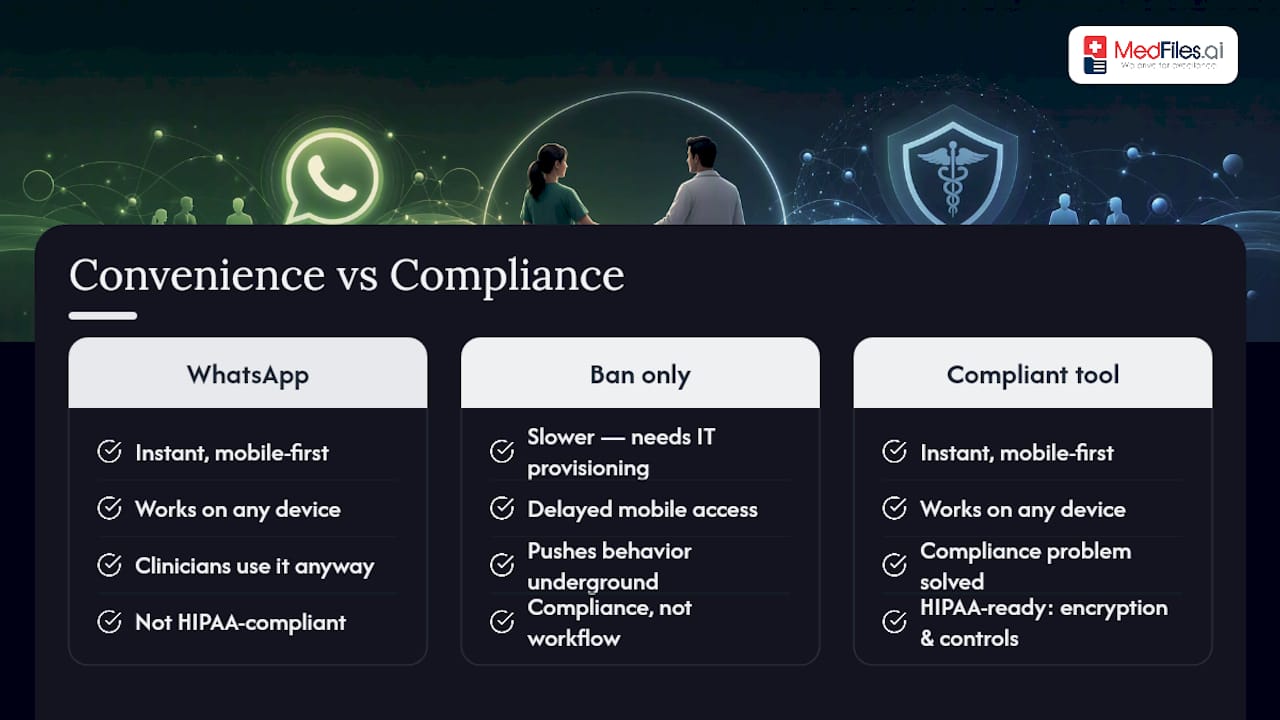
The organizations that get this right don’t just ban WhatsApp. They replace the specific convenience it offered: instant, mobile-first, works-on-any-device access, with a compliant tool that matches that speed. MedFiles.ai was built around that exact tension: families and caregivers need instant access to records during an emergency or a new specialist visit, and that access has to sit inside a HIPAA-ready structure with encryption and controlled sharing built in from the start, not bolted on afterward.
Blanket prohibition without a fast alternative just pushes the behavior underground. Give people a tool that’s actually as quick as WhatsApp felt, and the compliance problem mostly solves itself.
— Team
Replace WhatsApp Habits With a HIPAA-Ready Sharing Workflow
Medfiles gives patients, families, and the providers they work with a way to share medical documents that doesn’t rely on a personal messaging app never built for PHI. Every upload sits behind encryption and controlled sharing permissions, so a lab result or discharge summary moves between a family member and a specialist without ever touching an unsecured chat thread.
The platform’s secure sharing tools let you send specific documents to a provider or caregiver with a controlled link instead of a WhatsApp photo that’s now sitting in someone’s camera roll and cloud backup indefinitely. Multi-profile management covers an entire family or a pet’s records in one place, and the security and privacy architecture is HIPAA-ready by design rather than retrofitted. For organizations still relying on ad-hoc messaging for patient updates, WhatsApp alerts can stay in the loop for simple notifications while the actual records live in a system built to meet the standard WhatsApp can’t. Start a free trial, no credit card required, and see how quickly a family’s full medical history moves from scattered chat threads into one accessible, secure record.
Where This Guidance Comes From
This article draws directly on federal and institutional sources rather than general SEO guidance:
- HHS Security Rule guidance on required administrative, physical, and technical safeguards.
- HHS guidance on business associates and BAA requirements.
- Academic review of messaging-app security risks in healthcare contexts.
This article is general information, not a substitute for advice from a qualified doctor. Consult a qualified healthcare professional about your own circumstances before acting on anything here.
Sources
- HHS: Security Rule guidance
- HHS: Business associates and HIPAA
- NCBI/PMC: Academic coverage of messaging app security in healthcare